What “FDA Cleared” Actually Means for Red Light Therapy Devices (And How to Verify It)
If you’ve spent any time researching red light therapy, you’ve probably noticed that almost every device on the market makes some version of the same claim: FDA cleared, FDA approved, FDA certified. The language gets used so freely, and so interchangeably, that it starts to feel meaningless. But the distinctions matter enormously, and knowing how to verify them could protect your health, your investment, and if you’re a clinician, your business.
The Fastest Way to Verify Any Clearance Claim
Here’s the simplest and most reliable test for any red light therapy device: ask the company for the direct link to their clearance on FDA.gov. Not a certificate. Not a registration number. A link to the FDA’s own database where the full details of the clearance are displayed.
If they can’t provide that link, the device is not cleared. It’s that straightforward. Every legitimate FDA clearance has a corresponding page on FDA.gov that anyone can access. If a company hesitates, redirects, or offers a document that isn’t an FDA.gov URL, that tells you everything you need to know.
Cleared, Registered, and Wellness: Three Very Different Things
Part of what makes this landscape confusing is that there are multiple FDA-adjacent designations floating around the red light therapy market, and they are not equivalent.
FDA Registered means a manufacturer has notified the FDA of what they produce and agreed to operate under a Quality Management System. It does not mean their products have been tested or cleared for any specific treatments. A registered facility can make a product that has never been independently evaluated. No clinical claims can legally be made about it.
FDA Wellness Classification is a generic category that doesn’t allow a device to be marketed for any specific therapeutic purpose. What counts as “wellness” is open to interpretation, and making specific treatment claims about a wellness-classified device actually violates FDA regulations. This classification has no requirement for independent testing or specification verification.
FDA Cleared is the designation that actually means something. Clearance requires demonstrated safety and efficacy for specific indications. It means the device has been evaluated against a regulatory standard, not just registered in a database. And it means the claims made about what the device can treat are backed by documentation the FDA has reviewed.
The difference between these three categories is significant in practice. A clinician who uses a non-cleared device while claiming it’s FDA-cleared is not just making a marketing error. They’re potentially exposing themselves to serious legal liability if an adverse event occurs and their attorney discovers the misrepresentation.
Three Years in the Making
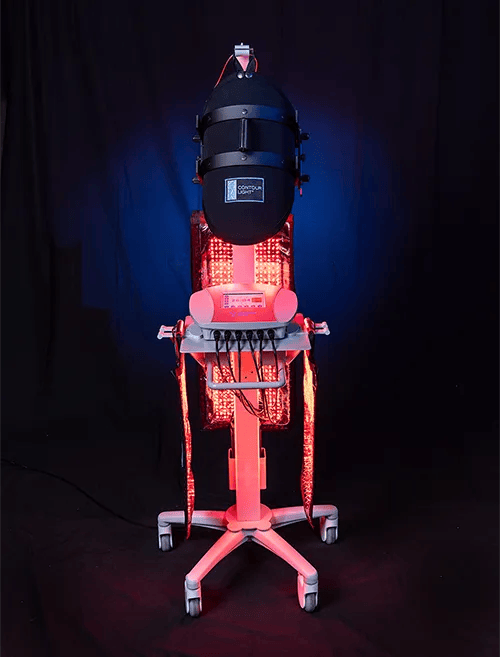
The Contour Aire didn’t happen quickly. Contour Research spent over three years in development, moving through design, testing, and the process of attaining the appropriate FDA clearances before bringing the system to market. That timeline is not an accident. It reflects a decision to do the process correctly rather than move fast and figure out the details later.
The result carries multiple FDA clearances, covering both non-invasive body contouring for the reduction of circumference in the hips, waist, and thighs, and therapeutic applications including temporary relief of minor muscle and joint pain, arthritis, muscle spasms, stiffness, and improved local circulation. The enclosed bed format and the independently verified specs build on that foundation with engineering that was designed to match the clinical standard the clearances represent.
The Scalp Panel
Here’s where it gets interesting. Red light therapy and weight loss aren’t competing approaches. They’re complementary ones, addressing different parts of the same goal.
Someone who is working on overall weight loss through diet and exercise is changing their body’s total energy equation. That process tends to reduce fat somewhat proportionally across the body, which is fine except for the stubborn areas that don’t follow the general trend. The belly that holds on longest. The hips that seem immune to the deficit. Those spots are where genetics and hormonal patterns have decided to park fat, and caloric restriction alone isn’t sending a targeted enough signal to move them specifically.
Red light therapy fills that gap. It doesn’t care what your diet looks like. It addresses those cells directly, in the locations you’ve been waiting on, independently of whether the rest of your body is in a caloric deficit or not. Used alongside a general weight loss approach, it cleans up the distribution problem that weight loss can’t solve on its own.
Used as a standalone treatment in someone who isn’t making other changes, it still produces real inch loss. But it’s working on shape, not scale. The expectation needs to match accordingly.
The Intended Use Regulation: A Subtle but Important Rule
Some manufacturers navigate the clearance question by simply not making direct therapeutic claims. Instead, they publish extensive information about red light therapy benefits in general, letting the reader draw their own conclusions. This approach may seem like a loophole, but the FDA has a regulation specifically designed to close it: Intended Use.
Under Intended Use rules, if a buyer purchases a device because they’ve been led to believe, through implied or stated assertions by the manufacturer, that it performs a certain function, that constitutes a violation even if the manufacturer never made an explicit claim. In other words, listing the benefits of red light therapy on a product page while selling a device that isn’t cleared for those benefits is still a problem, legally speaking. The implication counts.
The “One Product Cleared” Trap
There’s another specific situation worth flagging. At least one company in this space holds an FDA clearance for one of its products but markets a red light device that is not itself cleared, sometimes under the impression that the clearance transfers across the product line. It does not.
When verifying FDA clearance, always ask for the link that corresponds specifically to the device you’re purchasing. If the documentation covers a different product from the same manufacturer, the device you’re considering is not cleared. Using that device on patients while representing it as FDA cleared puts both the patient and the clinician in a difficult position.


What the Market Actually Looks Like Right Now
The red light therapy device market is, at this moment, largely unregulated in practice. A significant portion of devices are manufactured overseas and may not perform to their stated specifications in terms of power output, wavelength accuracy, or safety standards. The specs on a product page may not reflect what the device actually delivers, and without independent testing, there’s often no way to know.
As of now, there are only four devices in the entire category that hold actual FDA clearances: two pad-based systems and two red light beds. Contour Light and the Contour Aire are among them. That’s a small number in a crowded market, and it reflects how high the bar for genuine clearance actually is.
Why FDA Clearance Matters Beyond the Label
For patients, choosing a cleared device means choosing one that has been evaluated for safety and tested to perform as claimed. The results you’re told to expect have a documented basis, not just a marketing department behind them.
For clinicians, the stakes are higher. A practice that invests in marketing a red light therapy service is building a patient base around that offering. If the FDA determines a manufacturer is in violation of its regulations, that company can be shut down. Clinicians who own the device are then left without customer service, without repairs, and without recourse. The marketing investment, the patient relationships, the operational infrastructure built around that service: all of it becomes vulnerable.
Beyond that, there are subtler risks. One of the competing cleared pad-based devices is also available in a scaled-down home-use version. Patients receiving clinical treatments are likely to eventually discover that the same brand sells a version for personal use. When that happens, many will simply purchase one and stop returning to the clinic, often without explaining why. The clinic won’t know the reason that portion of their business declined. On top of that, patients who realize the device being used on them clinically is also sold as a home product may begin to question the level of care and professionalism they’re receiving.
These aren’t hypothetical outcomes. They’re predictable ones, and they’re the kind of business consequences that don’t show up immediately but compound over time.
The Standard Worth Holding To
FDA clearance is not a marketing claim. It’s a regulatory designation with specific requirements, independent testing, and documented evidence behind it. In a category where the terminology gets blurred constantly, and where the difference between “registered” and “cleared” can have real consequences for patients and providers alike, knowing how to ask the right questions is genuinely valuable.
Ask for the FDA.gov link. Verify that the link corresponds to the exact device you’re evaluating. And choose a system that has earned its clearance, not just borrowed language from one.