
Balance Beyond Fat Loss: How Stress, Sleep, and Hormones Affect Body Shape
Most people approach the problem of body shape as a math problem. Calories in, calories out. Move more, eat less. If the result isn’t changing, the assumption is that somewhere in the equation, the numbers aren’t right.
But there’s a significant portion of the population doing the math correctly and still not seeing the result they expect. The diet is clean. The workouts are consistent. The scale moves sometimes, grudgingly, but the shape doesn’t shift the way it should. The abdomen stays soft. The hips don’t budge. The lower back holds on to something that no amount of cardio seems to reach.
This isn’t a discipline failure. It’s a signal that something else is running in the background, something the calorie equation doesn’t account for. And until that something gets addressed, the math will keep coming up short.

Cortisol Is Doing More to Your Body Than You Realize
Stress gets talked about in vague, general terms in wellness culture. Reduce stress. Practice self-care. As if stress were a mood rather than a hormone, and as if the solution were a bubble bath.
The physiological reality is more specific, and more consequential. When the body perceives stress, it releases cortisol. That’s a normal, useful response. Cortisol mobilizes energy, sharpens focus, and prepares the body to respond to whatever threat it’s identified. The problem is that the modern threat landscape, inbox overload, financial pressure, relationship friction, a news cycle designed to provoke, looks nothing like what cortisol evolved to handle. The stress response fires continuously at a low level, and cortisol stays elevated in ways the body was never designed to sustain.
Chronically elevated cortisol does several things to body composition that have nothing to do with calories. It promotes fat storage specifically in the abdominal area, where there’s a higher concentration of cortisol receptors in the fat cells. It breaks down muscle tissue to provide quick energy, which lowers the metabolic rate over time. It increases appetite, particularly for high-calorie, high-carbohydrate foods, through its effect on hunger hormones. And it makes the body hold onto fat more aggressively as a survival mechanism, because from cortisol’s perspective, a stressful environment is a dangerous one, and dangerous environments call for energy reserves.
Someone who is chronically stressed is not working with a neutral body. They’re working against an active hormonal signal that is directly opposed to the shape changes they’re trying to make.
Sleep Is Not Recovery Time. It’s Regulatory Time.
The fitness industry has gotten better at talking about sleep, but it mostly frames it in terms of muscle repair and performance. Sleep more so you can train harder. Sleep more so your muscles recover faster. That framing is accurate but incomplete.
What sleep is actually doing, beyond repair, is regulating the hormonal systems that govern appetite, fat metabolism, and body composition. Two hormones in particular, ghrelin and leptin, are tightly controlled by sleep duration and quality. Ghrelin signals hunger. Leptin signals satiety. When sleep is shortened or disrupted, ghrelin goes up and leptin goes down. The body becomes simultaneously hungrier and less capable of recognizing when it’s full.
This isn’t a willpower problem in the morning after a bad night. It’s a hormonal state that persists through the day and creates a genuinely different appetite landscape than a well-rested body experiences. Studies on sleep-deprived subjects consistently show increased caloric intake, increased preference for high-fat and high-sugar foods, and reduced ability to resist cravings, not because those subjects have less discipline, but because their hormonal environment is pushing hard in one direction.
There’s also the insulin sensitivity piece. Poor sleep impairs insulin function, which affects how the body processes and stores carbohydrates. A body with reduced insulin sensitivity is one that deposits more of what it eats into fat storage rather than using it efficiently for energy. Over time, repeated poor sleep is one of the more reliable ways to worsen body composition independent of diet and exercise choices.

Hormones Determine Where, Not Just How Much
The most frustrating aspect of hormonal influence on body shape is that it’s not just about total fat mass. It’s about distribution. Where the body stores fat, and how stubbornly it holds onto it in specific locations, is governed almost entirely by hormonal patterns rather than caloric ones.
Estrogen, for instance, encourages fat storage in the hips, thighs, and lower body. When estrogen levels shift, as they do dramatically during perimenopause and menopause, fat redistribution often follows. Women who carried their weight in their lower body for decades suddenly find it accumulating in the abdomen instead. The total amount may not have changed significantly, but the location did, and so did the shape. No diet change triggered it. A hormonal shift did.
Thyroid function is another variable that gets underestimated. The thyroid regulates metabolic rate, and even subclinical thyroid dysfunction, the kind that doesn’t register as a clinical problem on standard panels, can slow metabolism enough to make fat loss disproportionately difficult. Someone with sluggish thyroid function is not eating differently than someone with normal function. They’re just burning less at baseline, which means the same food intake creates a different outcome.
Testosterone, relevant for both men and women, influences muscle retention and fat distribution in ways that become more pronounced as levels naturally decline with age. Lower testosterone means less muscle, a lower metabolic rate, and a tendency toward increased fat storage in areas that were previously well-managed by a more favorable hormonal environment.
None of these factors show up in a calorie count. None of them are addressed by working out harder. And none of them are visible on a scale until the downstream effects have been accumulating for a while.
What This Means for Body Contouring
Understanding the hormonal and lifestyle dimensions of body shape changes how you think about targeted treatments and what they can realistically accomplish.
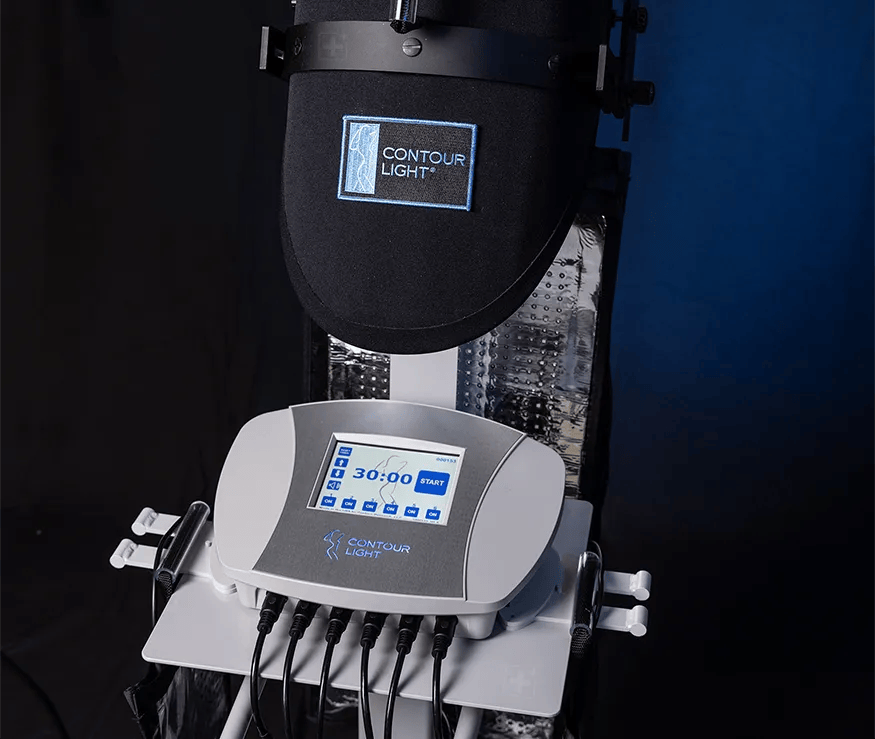
Red light therapy, and Contour Light specifically, works directly on fat cells in the locations where stubborn deposits have built up. It doesn’t need the body’s hormonal environment to cooperate in order to prompt those cells to release what they’re storing. That’s the advantage of a localized, targeted mechanism. It sidesteps the systemic variables and addresses the cell directly.
But here’s the honest version of that: if the conditions creating the deposit in the first place haven’t changed, the cells that were just emptied are going to be working against a hormonal current that wants to refill them. The treatment produces real results. Those results are more durable when the broader environment supports them.
This isn’t a reason to delay treatment until everything else is perfect. That day rarely comes. It’s a reason to treat body contouring as one piece of a larger picture rather than a standalone solution, and to pay attention to the stress load, the sleep quality, and the hormonal signals that are shaping the body alongside everything else.
The Variables You Can Actually Influence
The hormonal influences on body shape can feel discouraging when you first encounter them, as if the body is being controlled by forces entirely outside your reach. Some of them are. Genetics are genetics. Age-related hormonal shifts happen on their own timeline. But the downstream effects of stress and sleep are more actionable than most people give them credit for.
Cortisol responds to genuine recovery time, not just the absence of work but the presence of actual rest. Physical activity is one of the most effective cortisol regulators that exists, which creates a reinforcing loop between movement and stress management that goes beyond the physical outcomes. Sleep quality improves with consistent sleep and wake times, reduced light exposure in the evening, and lower caffeine intake in the afternoon hours, changes that are small in isolation but compound meaningfully over weeks.
The relationship between these factors and body composition is slower than a new diet or a new workout program. It doesn’t produce visible change in a week. But it’s the difference between a body that is working with the changes you’re trying to make and one that is quietly working against them, and over time, that difference is substantial.

Shape is a Systems Problem
The most useful reframe for anyone who has been doing the work and not getting the result is this: body shape is not a math problem with one variable. It’s a systems problem with many.
Calories matter. Movement matters. But so does sleep, so does stress, so does the hormonal environment that governs where and how the body stores what it has. Addressing only the inputs while the background variables run unchecked is like trying to fill a bathtub with the drain partially open. Progress happens, but not at the rate the effort deserves.
The path that actually works combines targeted tools for the localized problems, systemic attention to the factors that drive fat distribution in the first place, and an honest accounting of which variables are in play. That’s a more complete picture than most body composition conversations allow for, and it tends to produce more complete results.
About Us
The Contour Light® system is FDA-cleared for use as a non-invasive dermatological aesthetic treatment for reducing the circumference of the hips, waist, and thighs. Contour Light® is also FDA-cleared for the temporary relief of minor muscle and joint pain, arthritis, and muscle spasms, relieving stiffness, promoting the relaxation of muscle tissue, and temporarily increasing local blood circulation.
The Technology
Purchase a Contour System
Address
Phone
Follow Us
About Us
The Contour Light® system is FDA-cleared for use as a non-invasive dermatological aesthetic treatment for reducing the circumference of the hips, waist, and thighs. Contour Light® is also FDA-cleared for the temporary relief of minor muscle and joint pain, arthritis, and muscle spasms, relieving stiffness, promoting the relaxation of muscle tissue, and temporarily increasing local blood circulation.